

Oct 19, 2026
Automatic meat recognition with AI: how it works and what it is worth to a meat plant
An AI model trained on your own cuts names the product in every crate. How that works in plain terms, what it brings in routing, labour, error rate and data, and where it fails.
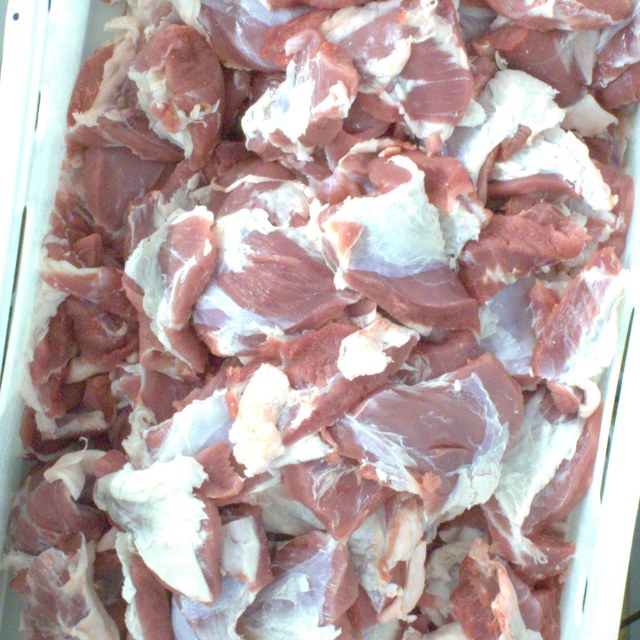
The most repeated decision in a meat plant is still made by eye
Somewhere between the deboning table and the packing hall, every crate gets a product code. In most plants that code comes from a person: they look into the crate, decide what they see, and type. Ham or shoulder. This trim spec or the other one. Skin-on or skin-off. At two degrees, at line speed, in hour seven of the shift, a few thousand times a day.
Nothing stops when the code is wrong. The crate rolls on to the wrong pallet, the wrong order or the wrong customer, and the mistake surfaces later: in stock that doesn't add up, a delivery that comes back, a yield figure nobody trusts. And because no crate ever gets a second look, nobody in the plant can tell you how often it happens. That one keystroke is what routing, palletising, stock, order picking and traceability are built on.
Automatic meat recognition is the camera taking over that decision. This article explains how it works, in enough detail to judge it, and what it is worth: in crates that land where they should, in people who no longer have to type, in an error rate you can finally measure, and in the data the rest of the plant's digitalization is waiting for.
What automatic meat recognition is, and what it is not
Recognising meat by camera is not new in the slaughterhouse. EU rules have allowed automated grading methods for pig, beef and sheep carcasses for years: an apparatus looks at the carcass and estimates the lean meat percentage or the conformation class, approved per member state after a formal test. That works because a carcass is one object in one position.
Then the carcass is cut into forty, sixty, a hundred products, and recognition goes back to human eyes. That is the gap automatic meat recognition closes: a camera over the line, a model trained on your own cuts, and an answer per crate or per product. "Which product is this?" Classification, in our words.
It helps to be precise about what that question is not. It is not "is this good?": that is inspection, a different model on the same camera. It is not "how much lean?": that is grading, and in the cutting room it needs other sensors than a colour camera. Weighing does belong to it: under the hood a scale records the crate's net weight, from the station's own scale or the one you already have, and that number goes into the record next to the product. It checks the camera too: a crate whose weight doesn't fit the recognised product is flagged. One question answered reliably, with the weight as its second opinion, is worth more than four answered sort of.
How it works, in the five parts that decide whether it works
A recognition point is a camera, light, a scale, a computer and a model. The parts that decide whether it works on a real line are these.
- A controlled picture. The difference between a ham and a shoulder, or between two trim specs, lives in the colour and tone of the fat and the texture of the surface. Hall light, glare on wet meat and the night shift's different lamps destroy exactly that signal. So the camera sits under a closed hood with its own LED bars, lit so there is no glare on wet meat or film, and hall light stays outside: the night shift gets the same picture as the day shift.
- A model trained on your products, not on someone else's pictures. Your products are your cuts, in your crates, to your trim specs, with pairs that differ only in what a customer asked for. The difference between two similar cuts lives in texture and fat structure, which is exactly what ordinary image recognition throws away. The model that runs on your line is trained on your crates and nothing else.
- Labels your operators already produce. Training a model needs labelled images, and the usual way to get them is a labelling project nobody has time for. In a cutting room you don't need one. Every code an operator types today is the label for the photo the camera just took. Thousands of labelled images a day, at zero extra work, from the people who know the products best.
- A confidence, and a person for doubt. Every answer comes with a calibrated confidence. Above the threshold you set, per product, the station writes the code. Below it, a beacon lights up and an operator decides, at the line or in a side lane so the flow keeps moving. That answer becomes training data. You choose the trade-off: send more crates to a person and errors approach zero, send fewer and you save more labour.
- The decision inside the station, the record in your systems. The model runs on a computer in the station itself, so an answer takes a fraction of a second and the line keeps running when the network does not. Barcode, product, weight, photo and timestamp land on MeshOS, our data layer, in open formats: an API, a message queue, or the same input path the terminal uses today. From there the record reaches your ERP, MES or line control, and nothing is locked into one vendor's database. The station reads from your PLC. It writes to it only if you want it to and the line needs it; otherwise nothing changes in your PLC and nothing needs re-validating.
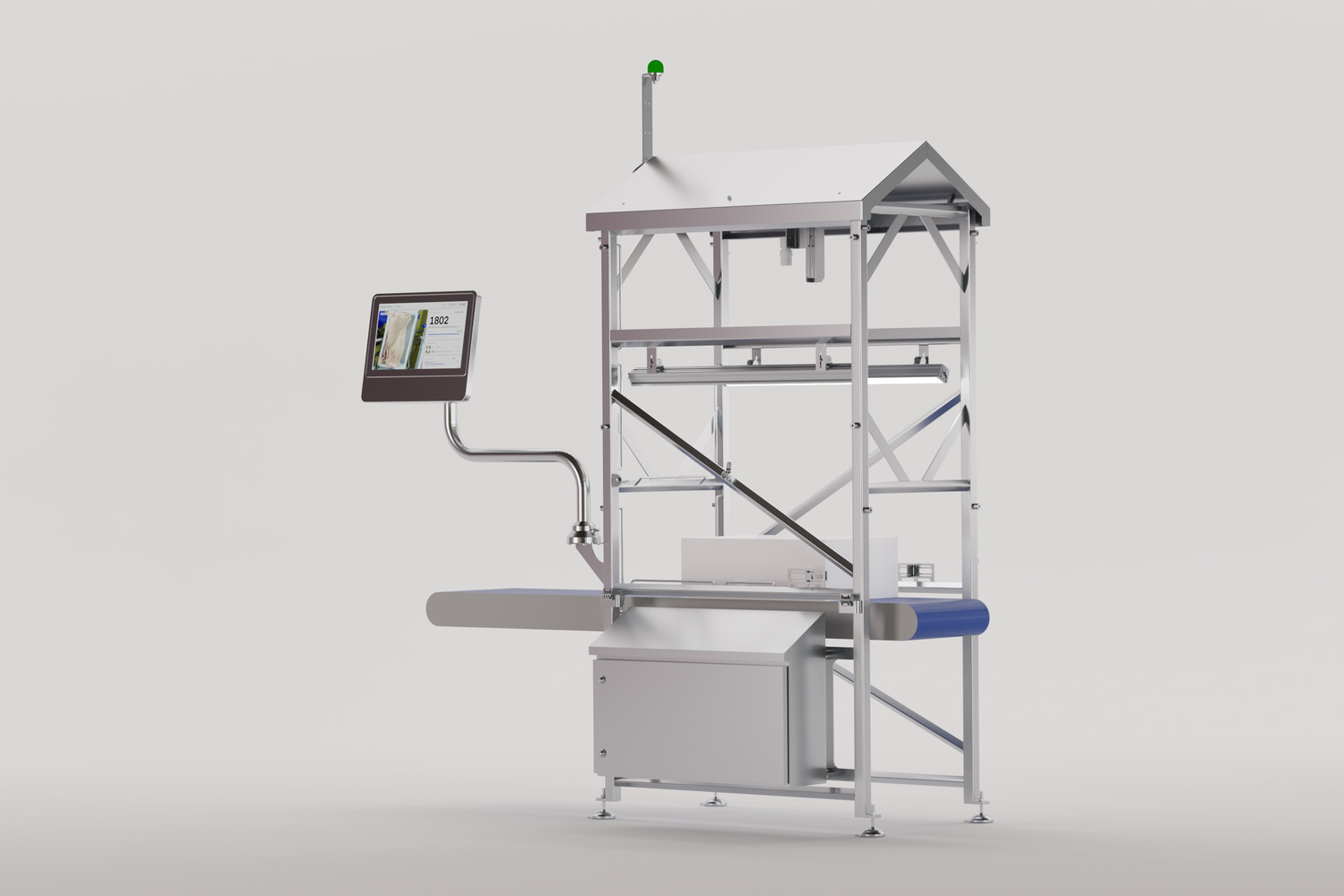
This is how we built MeatVision, and it is also how we would judge any other recognition system: show me the picture, show me whose labels trained it, and show me what happens when it is not sure.
What it brings: five outcomes you can put a number on
The right crate on the right pallet
A wrong code is cheap at the moment it is made and expensive everywhere after. The crate goes on the wrong pallet, so someone searches, pulls it back and re-books it, or it ships. Then the customer finds it: a claim, a credit note, a return transport for a product that may not be saleable anymore, and a customer who starts checking everything you send. The recognition station flags a doubtful crate before it is routed, not after the pallet is wrapped. The number to watch here is yours: claims per month for wrong product, and the hours your office spends settling them.
Flow at the indexing point
Where crates stop for a person to look and type, the indexing point sets the pace of the line. With strobed light and a short exposure the picture is sharp on a moving crate, so the stop can go. Where crates stop today, the station works there as it is, and you remove the stop when you are ready. The outcome is the same either way: one fewer place where the line waits for a keystroke.
An error rate you have never had
Nobody knows the manual error rate, because no crate gets a second opinion. Ask three people in the plant and you get three guesses. The station gives you the number for your own line: in the first weeks the model runs in shadow, answering every crate while nobody sees the answer, and you get its error rate next to your operators' current one, per product. A product goes automatic only after it has earned it against that baseline.
The typing goes, the people stay
Looking into every crate and typing a code is repetitive work, and the people who do it are getting harder to find. In the Dutch meat sector, 37% of all workers were migrant workers in 2020 and roughly half the workforce came through agencies; from 1 March 2028 agency work in slaughtering, cutting and processing is banned. Meanwhile Dutch abattoirs run below capacity: they can process more than 300,000 pigs a week and received around 270,000 in the tightest weeks of early 2026, so the same fixed costs are spread over fewer animals. Henrik Andersen, who leads engineering at Danish Crown, said in 2023 what most plants know: deboning is "extremely difficult to do robotically because one cannot see" what you are doing, so the company's automation goes into logistics, internal transport and cutting. The knife stays in a human hand. The typing does not have to. An operator at a recognition point handles the exceptions and is free for the rest of the shift.
A photo of every crate
Every crate leaves the department with a photo, a product, a weight and a time, tied to its barcode and lot. When a customer says the delivery was wrong or short, you scan the barcode and show them the crate. Evidence instead of a discussion. The same record is the lot link EU food law asks you to keep for food of animal origin: one step back, one step forward, with a lot reference, now without a typed code in the chain.
One record per crate is where the cutting room's data starts
Here is the part that outlasts the labour saving. Most digitalization in a meat plant is about reading data that already exists: scale weights, cold store temperatures, PLC stops. A global survey of 1,500 manufacturers found that only 43% of the data they collect is used effectively; the rest is already there, waiting. The cutting room is different. Between the carcass scale and the packing scales there is no data, because nobody counts what a knife does. The recognition station creates the first reliable record in that gap: which crate, what product, how much, from which lot, when.
Everything else in the department is that record, read from another side:
- Live yield is output kilos per cut against the lot's input weight, counted as crates pass instead of in tomorrow's report. We wrote down what that takes in digitalizing the deboning department.
- Batch progress is the same crates counted against the order: planning sees when order X is complete, and the line stops making what nobody ordered.
- Order verification checks product and quantity against the active order before the pallet is wrapped.
- Stock becomes a live figure per product instead of a count on Friday.
And the dataset itself has value. Thousands of labelled photos of your products a day, on your own storage, is exactly what any later automation needs: a sorter, a palletising robot, a stock system. Danish Crown is putting its robots into logistics and internal transport first, and every one of those steps needs to know what is in the crate. On MeshOS the crate records sit next to weights, stops and temperatures per batch, so the next step starts from there, not from zero. That is why our meat industry page names the cutting room as the place to begin.
Honest about automatic meat recognition: where it fails
- Two products that look the same to a trained eye cannot be told apart by a camera either. Same cut, two weight classes, or the same cut for two customers. For those the station needs another signal: the weight on the scale or the active order. Where neither separates them, the crate goes to a person, and we say so before the pilot.
- A new product goes to the operator until the model has seen enough of it. Common cuts are ready in weeks; a product that appears once a month takes as long as it takes to appear.
- Products drift. A new supplier, a new trim spec, a changed crate colour: the model notices it as falling confidence, and that product goes back to human checking while the rest keeps running. A weekly audit of confident decisions catches what confidence does not.
- The first model will confuse a few pairs, and it tells you exactly which. Most are solved with more examples of those pairs. Some are not, and the honest answer is that those stay with people.
- The camera only sees the top of the crate. It catches blue plastic and glove pieces on the surface, and it does not replace your metal detector or your grading.
- A camera in a plastic box lasts a week in a washdown area. The station is sealed stainless with sloped surfaces, the computer sits inside, and installation goes into a cleaning window. That is engineering, not an option.
Frequently asked questions
Do we need to label thousands of images before it works?
No. Your operators label every crate today by typing its code, and that code becomes the label of the photo. The only extra labelling is a few hours a week of your butchers reviewing the crates the model doubted.
What does it need from our ERP or MES?
Only what your terminals use today. The record arrives through the interface that already exists: an API, a message queue, or the same input path as the terminal it replaces. The station reads from your line control and writes to it only if you want it to.
Does the EU AI Act make this a high-risk system?
No. The high-risk list of the AI Act covers areas such as biometrics, critical infrastructure, decisions about workers and law enforcement, and a camera that names the cut in a crate is on none of them. It is not a safety component of the line either. It looks into crates, not at people, which is also what keeps it out of a works council discussion.
Can the same camera check quality or find foreign bodies?
Partly. It sees what lies on top: blue plastic, glove pieces, an overfilled or dirty crate, a missing label. Grading lean content or finding bone fragments inside the meat is a different sensor and a different model. We would rather tell you that now than after the pilot.
How long before it runs on its own?
That depends on how fast your rarest products pass the camera. Common cuts earn automatic status in weeks; rare ones later. Each phase ends on numbers you agree in advance, not on a date, and for the first two phases nothing changes for your operators at all.
Start with the one decision that goes wrong most often
You do not have to automate the cutting room to get this. You have to pick one indexing point, hang a camera over it, and let your operators' own entries teach it. Within weeks you know two numbers you have never had: how often the typed code is wrong today, and how often the camera is. From there every crate leaves the department with a record the rest of the plant can build on.
If you want to see which of your cuts a camera can tell apart, send us a few hundred photos or let us put a camera over one line for a week: that is how a MeatVision demo starts. Our AI vision classification page covers the same method for products that are not meat.