

Oct 7, 2026
Digitalizing the deboning department: live yield, batch progress and crates that identify themselves
The deboning room decides the margin of a meat plant, and its numbers arrive a day late. What live yield, batch progress and automatic crate indexing take in practice, and where to start.
The margin is made at the deboning table and reported the next morning
You find out what a lot of legs yielded after the last crate has been weighed out, when the cutting room is already two lots further. The deboning department is where a meat plant earns or loses its margin: a trained hand leaves less lean on the bone than a new one, and multiplied over a shift that is the difference between a good week and a bad one. Yet of all departments it is the one where the numbers arrive last. Carcass or primal weights come from the slaughter line or the goods-in scale. Cut weights come from the packing scales, hours later. What happened in between is reconstructed in a spreadsheet the next morning, by someone who was not standing at the table.
Digitalization in the meat industry is usually sold as a plant-wide program. In the deboning room it comes down to three questions a foreman asks every day and cannot answer in time: what is this lot yielding right now, how far along is the batch for order X, and what is actually in that crate.
Why the deboning room is the last to get numbers
Deboning stays manual work. The French pork institute IFIP summed up why in its analysis of labour shortages in European slaughterhouses: every customer wants a different cut, every carcass is different, and pork cutting needs more space and heavier machinery than poultry. The knife work is hard to automate, and manual work is hard to measure. Nobody counts what a knife does.
The people doing that work are getting harder to find and keep. In the Dutch meat sector, SEO Economisch Onderzoek counted that 37% of all workers were migrant workers in 2020, and about half at slaughterhouses. Roughly half the workforce comes through temp agencies, and in July 2026 the Ministry of Social Affairs announced a ban on agency work in slaughtering, cutting and processing from 1 March 2028. Every yield sheet filled in by hand and every crate code typed at a terminal depends on people the sector will have fewer of.
And the room itself fights back. It runs at a few degrees above freezing, gets hosed down every night, and a tablet or a paper list lasts about as long as you would expect. So paper, memory and a terminal that was already there survive, and digitalization waits.
The useful question is therefore not "how do we robotize deboning". It is: how do we know what the people at the table are producing, while they are producing it, without adding a single step to their work.
Live yield: kilos out against kilos in, per lot, while it runs
Yield is a simple division: lean out per cut, divided by input weight per lot. Making it live takes three inputs, and most plants already have two of them in some form.
- Input weight per lot. The carcass scale on the slaughter line, or the goods-in scale for bought-in primals, with the lot number attached. Most plants have this weight; fewer have it in a place other systems can read.
- Output weight per cut, the moment the crate leaves the department. Every crate weighed and linked to a product code and the running lot. Not at packing, hours later and after mixing with other lots.
- A lot boundary the system knows. When lot B starts on the line. Usually from the active order in your ERP, sometimes a button at the line.
With those three, yield per cut is a running number instead of a report. By mid-morning you see that today's lot gives less ham and more trim than it should, and you can still call the supplier, check the trim spec, or move a crew, while the lot is on the table. Yield per supplier, per line and per shift falls out of the same data. US trade press puts the difference between an experienced and a new deboner at 1 to 3 percent per cut; at the lean prices of the last two years, one percent of yield on a deboning line is a figure your controller will want to see per week, not per quarter.
Two honest notes. Yield per individual operator only works where one person's output goes into their own crate. On many lines a table shares crates, and then you get a table number. That is still a number you do not have today. And expect the first week of live yield to be ugly: it mostly reveals where crates are weighed with the wrong tare, where two lots were mixed on the line, and where product codes were typed wrong. That is not a failed project. That is the cleanup you needed to do anyway, now with evidence.
Batch progress: how far is order X, without the phone call
Planning calls the foreman. The foreman walks to the pallets and counts crates. Twenty minutes later the number is already old. In the meantime the line produces "one more crate to be safe", and in a variable-weight business that crate becomes stock sold at trim price next week.
Batch progress is the same crate record counted against the order: crates and kilos done, what is still expected, an estimated finish time. Planning sees the order complete and releases the next one. The packing hall knows when product arrives. The line stops at the ordered quantity instead of at the end of the lot. Nothing extra is measured here; it is the yield record, read from the other side.
The crate is the unit of truth, and today a person types what is in it
Everything above stands or falls on one record: which crate, what is inside, how much, from which lot. In most cutting rooms that record is created at an indexing point. An operator looks into the crate, types a product code at a terminal, a scale takes the weight, and a label or a routing decision follows. Thousands of times per shift. Ham or shoulder, this trim spec or that one: cuts that look nearly identical, at line speed, at two degrees, in hour seven of the shift.
A wrong code stops nothing, which is exactly the problem. It sends a crate to the wrong pallet, the wrong order or the wrong customer. It books kilos of ham under trim, so the yield figure nobody trusts gets a little less trustworthy. And it breaks the lot link that EU food law asks you to keep for every consignment of food of animal origin: one step back, one step forward, with a lot reference. Nobody knows the error rate, because no crate ever gets a second look.
What a camera does at the indexing point
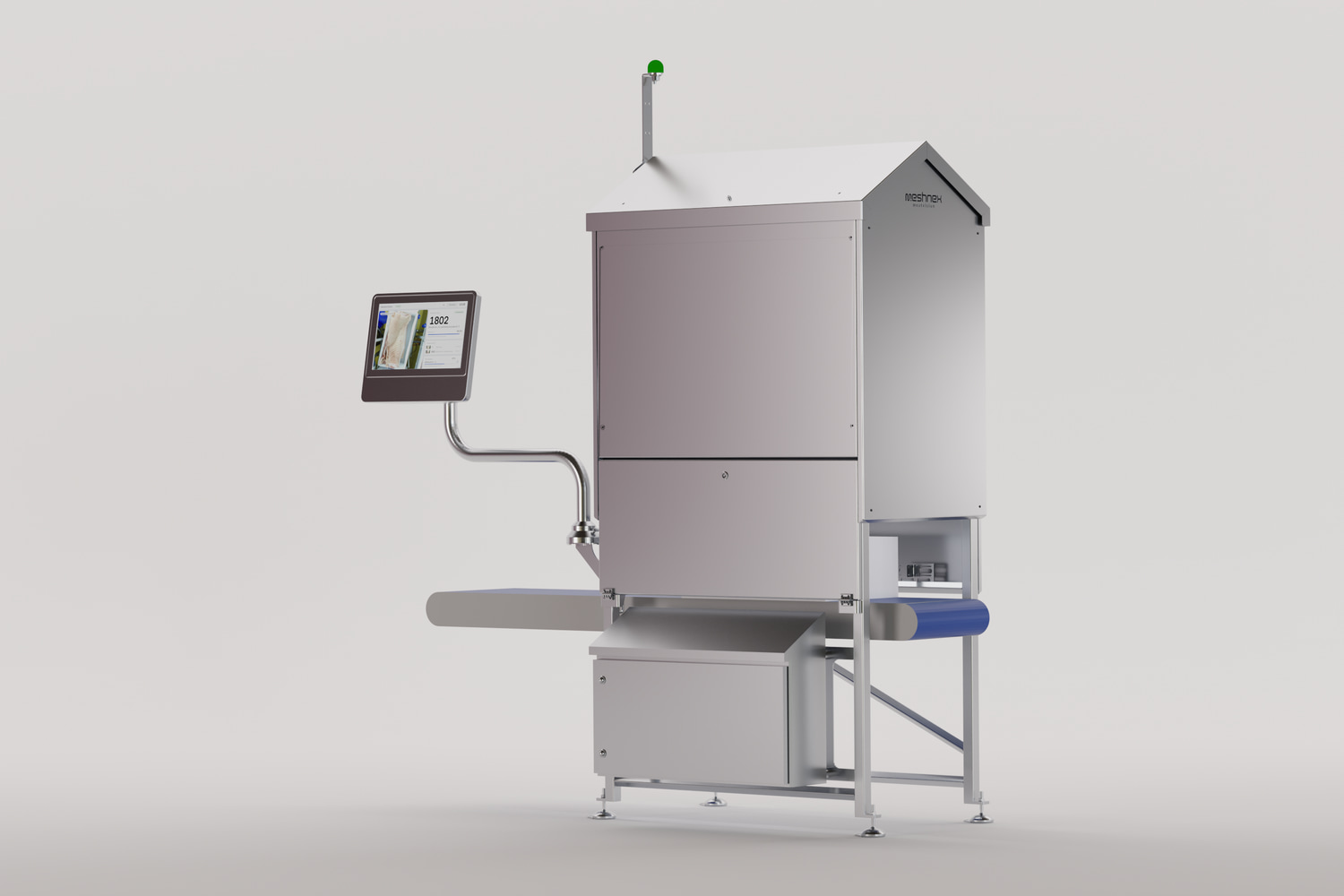
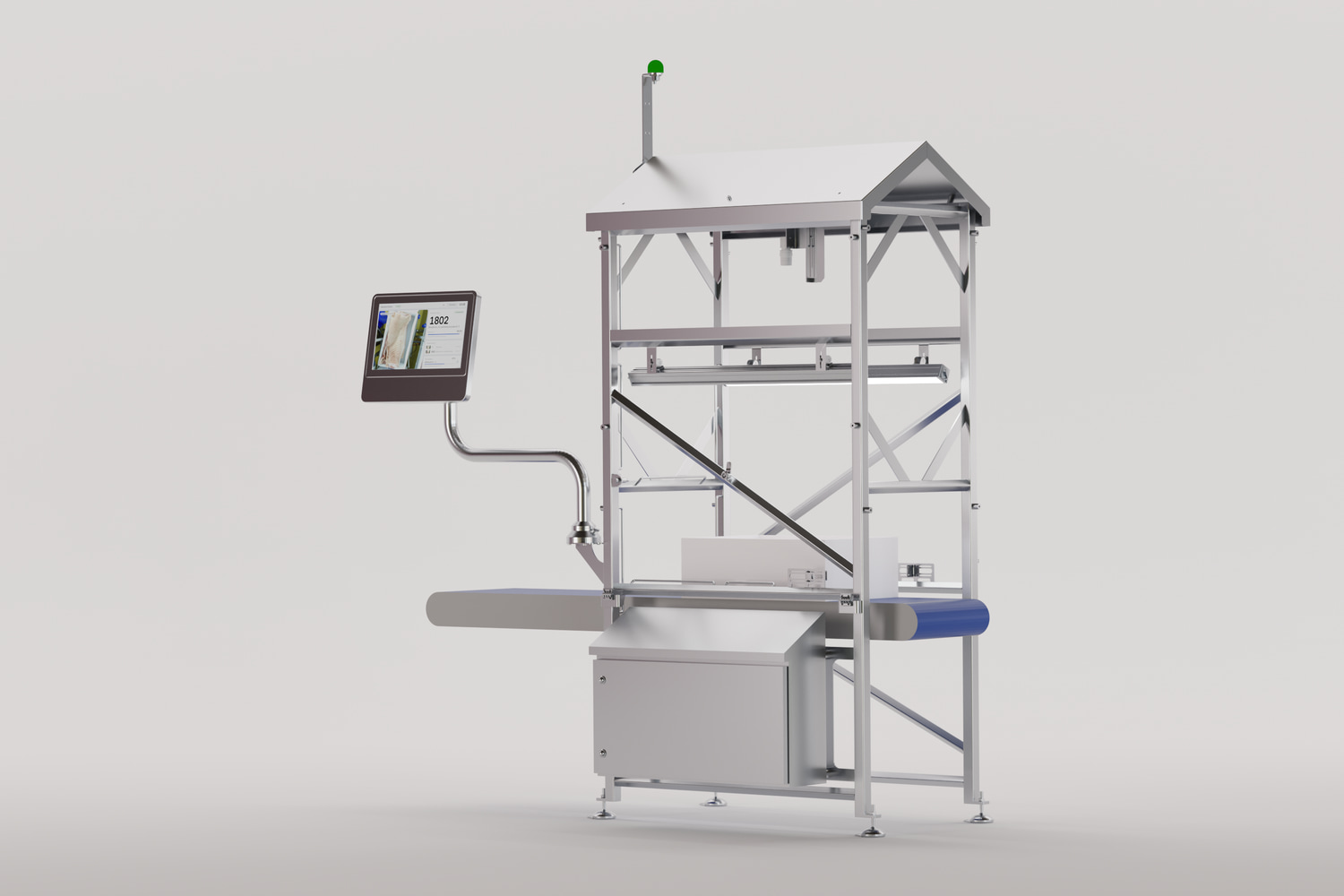
For that step we built MeatVision: an AI vision station over the conveyor. It reads the crate's barcode, a model trained on your own cuts names the product, the weight is linked, and one record goes to your ERP, MES or line control, while the crate keeps moving. The decision is made on a computer inside the station. Images stay on your site.
What makes this work is less the model than the way it earns its place. Your operators already label every crate, every day: each typed code becomes the label for the photo the camera took. For weeks the model then runs in shadow, answering every crate while nobody sees the answer. You get its error rate on your real production next to a number you have never had: your current manual error rate. A product goes automatic only after it has earned it, one cut at a time. Below the confidence you set, the crate goes to a person, at the line or in a side lane, and that answer becomes training data.
The limits are real and we say them up front. Two products that cannot be told apart by eye, such as the same cut in two weight classes or for two customers, need another signal: the weight, or the active order. A new product goes to the operator until the model has seen enough of it. And the first model will tell you exactly which pairs of cuts it confuses; most are solved with more examples of those pairs, some are not.
Where to start: one line, one record, one number you trust
The order matters more than the ambition. What works in practice:
- The crate record first. At the indexing point, make sure every crate produces product, weight, lot and timestamp in one place that other systems can read. Even while the code is still typed.
- Input weights with a lot number. From the slaughter scale or goods in. Without them yield is a guess with decimals.
- Live yield on one line, one lot type. Use the first weeks to find the wrong tares and the mixed lots, and fix them on the floor.
- Batch progress for planning. Same data, a second screen.
- Then take the typing away. The camera replaces the keystroke, with your operators' entries as its training set.
None of this requires new scales or a new line. Weights, counts and stops are read from the equipment you have, read-only, through an edge computer in an IP-rated enclosure, and installation is planned in cleaning windows. In many plants the first live data is visible within 48 hours of connecting a line. The same data layer that holds the crate records also holds the cold store temperatures and the CCP checks, which is why we describe the deboning room as the place to begin on our meat industry page, not as a separate project.
Frequently asked questions
Do we need new scales for live yield?
Usually not. Most deboning departments already weigh crates at the indexing point or at packing. What is missing is the link between that weight, the product code and the running lot, in a place other systems can read. That is a data problem, not a hardware problem. Where crates are not weighed at all before packing, a scale in the station is the simplest fix.
Can we see yield per operator?
Sometimes. It works where one person's output goes into their own crate, which is common on boning lines with individual stations and rare on shared tables. Where it does not, you get yield per table, per line and per shift, which already shows most of the variation. Introducing per-operator numbers is also a works council conversation, and we treat it as one.
What does automatic crate indexing need from our ERP?
Only what your terminals use today. MeatVision delivers product code, barcode and weight through the interface that already exists: an API, a message queue, or the same input path as the terminal it replaces. It reads from your line control and never writes to it, so there is no PLC change and no re-validation of the line. Talking to whatever is on the floor is the work we do every week: Siemens, Beckhoff, Rockwell and Omron PLCs over OPC UA, Modbus or S7, and ERPs from the large suites down to the custom package a plant has run for twenty years. And the station does not stand on its own. It runs on MeshOS, the same data layer that holds weights, stops and temperatures per batch, so you are not buying an island with its own database. The crate records sit next to the rest of the plant's data, and the next step, whether that is live yield, batch progress or a palletiser that subscribes to those records, starts from there instead of from zero.
Does this survive a washdown area?
Yes, if it was designed for one. The station is a sealed stainless enclosure with sloped surfaces, the edge computer sits inside it, and the camera looks through a closed hood.
One record per crate changes what the rest of the plant can do
Automatic sorting, palletising robots, order verification before the pallet is wrapped, a live stock figure: none of it works with a crate nobody has identified. As long as a person has to look and type, every step after the indexing point inherits that person's speed and that person's mistakes. Give every crate a reliable record the moment it leaves the deboning room, and yield, batch progress and traceability stop being tomorrow's report. The rest of the automation has something to build on.
If you want to see which of your cuts a camera can tell apart, send us a few hundred photos or let us put a camera over one line for a week: that is how a MeatVision demo starts. If the yield number is the bigger pain, we connect one line to MeshOS for free, read-only, so you see what your own crate data is worth before you decide anything.