

MeshOS module
Agentic AI for manufacturing: agents that watch your factory and act
Your factory produces more data than anyone can watch. Dashboards show what happened, but someone still has to spot the deviation, find the cause and start the follow-up: and that someone has a full agenda. AI agents in MeshOS take over the watching. They monitor your machine data around the clock, flag what matters with the context attached and prepare the follow-up, from work order to shift report. You keep the decision; the agent does the legwork.
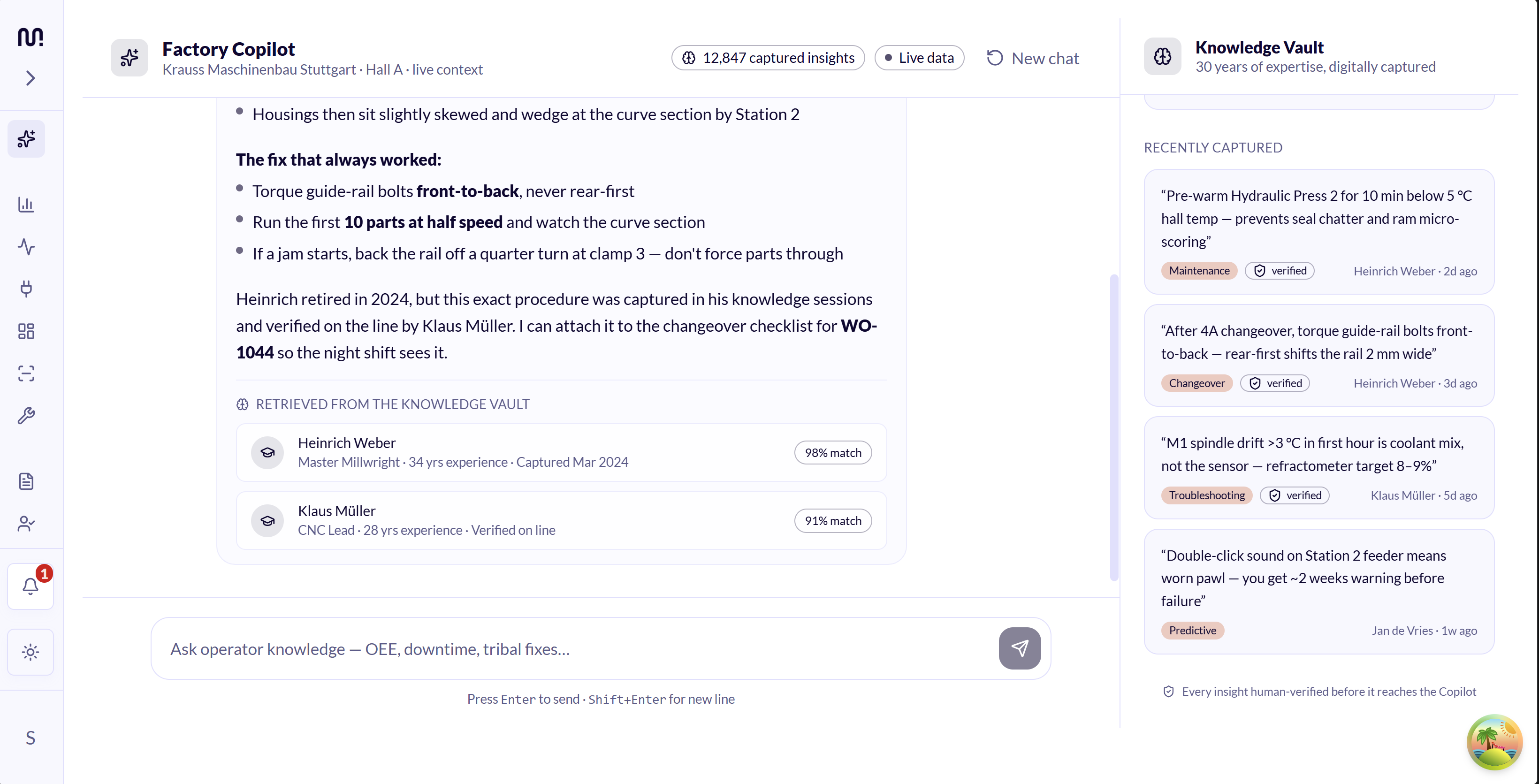
Seeing everything is not the same as acting on it
Factories have never had this many dashboards, sensors and alerts. Yet in MaintainX's 2026 State of Industrial Maintenance survey of more than 2,200 maintenance leaders, most organizations say unplanned downtime is not improving. The tooling watches; the follow-up still depends on someone finding time.
The data to catch this earlier is already there. What is missing is not another chart: it is something that watches, concludes and sets the follow-up in motion.
AI agents
What an AI agent in your factory actually does
An AI agent is software with a job, boundaries and initiative. A chatbot waits for your question and a dashboard waits for your glance; an agent watches its own domain and comes to you. In MeshOS that looks like a digital colleague with one clear task:
That combination, watching, judging and preparing inside set boundaries, is the difference between an agent and another notification rule.
Why most agentic AI projects stall
Gartner expects over 40% of agentic AI projects to be canceled by the end of 2027: costs run up, the business value stays vague or the risks never get under control. On factory floors, the pattern behind those failures is remarkably consistent:
None of these are AI problems. They are data and governance problems, and they are solvable: a foundation that serves live data with its context, and boundaries that are explicit from day one. That is the order MeshOS enforces.
- The pilot runs on a data export instead of the live factory: an impressive demo that never reaches production.
- The agent sees numbers without context: a value changes, but which machine, order or batch it belongs to is anyone's guess.
- There is no route from flag to action, so everything after the alert is still manual work.
- Boundaries were never defined: either nobody dares to let the agent act, or it acts and nobody can check it.
- The goal was 'do something with AI' instead of one measurable outcome.
How AI agents work in MeshOS
MeshOS already collects your machine data and gives every value its context: machine, line, order, batch, time. Agents run on top of that living dataset, and the order matters: first the foundation, then the agent.
In practice it looks like this:
The agent is not another system to feed: it puts the data your factory already produces to work.
- You give an agent one job: guard the reject rate on line 2, watch the energy peak, write the shift handover.
- The agent works on live, contextualized data: the same trusted numbers your dashboards already run on.
- Flags arrive with evidence and a prepared follow-up, in the channel your team already uses.
- You define per action what runs automatically and what waits for approval.
- Every observation, conclusion and action is logged in the audit trail.
- Agents run inside your MeshOS environment: cloud on European servers, hybrid or fully self-hosted.
Use cases
Six agents we build for factory floors
Every factory has watch-and-follow-up work that eats hours. These are the agents that come up most, each running on data MeshOS already collects:
Which agent comes first differs per factory. The best candidate is the watch job that costs your team the most hours today, or the misses that hurt most.
What it's really about: the follow-up actually happens
The value of an agent is not the flag. It is what stops slipping through: three shifts a day, no attention gaps, no 'we saw it too late'.
That is the yardstick for agentic AI: not what the agent can do, but what stopped going wrong.
For every role
One platform, agents for every role
The same foundation, a different agent per job.
Honest about agentic AI: what it can't do
Agentic AI is having its hype moment, and hype is a bad basis for buying decisions. Three limits belong in the story, and they shape how we build:
And an agent earns trust the way a new colleague does: by being right, visibly, again and again. Every agent therefore starts in advisory mode and only gets more room when its track record justifies it.
Start with one agent, not with an AI program
The way to make agentic AI pay off is unspectacular: one bounded job, one measurable outcome, expand on proof.
Step 1: pick the watch job
Together we choose one job with a measurable outcome: fewer unexplained stops, drift caught per batch, the handover written automatically.
Step 2: check the foundation
We verify the data the agent needs is live in MeshOS and carries its context. Machines already connected? Then this step is short. Not yet? Then we start there, and say so.
Step 3: run advisory-first
The agent flags and prepares; your team judges every suggestion. Hits and misses are logged, so trust grows on a track record instead of a demo.
Step 4: widen the boundaries
Actions that proved themselves get automated. New agents join on the same foundation, step by step, with the audit trail underneath.
Proof in practice
Watching and acting in the field
Real projects where watching turned into acting.
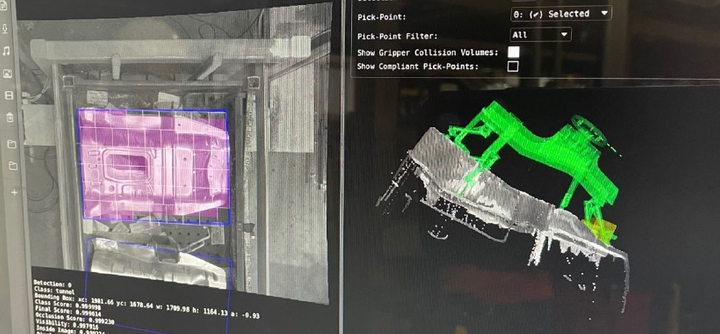 Quality early warning
 Scrap predicted before it comes off the line
Process parameters temperatures, pressures, cycle times feed a model that flags drift towards rejects while parts are still in the machine. Operators correct course instead of sorting scrap afterwards, and every intervention is logged against the batch.
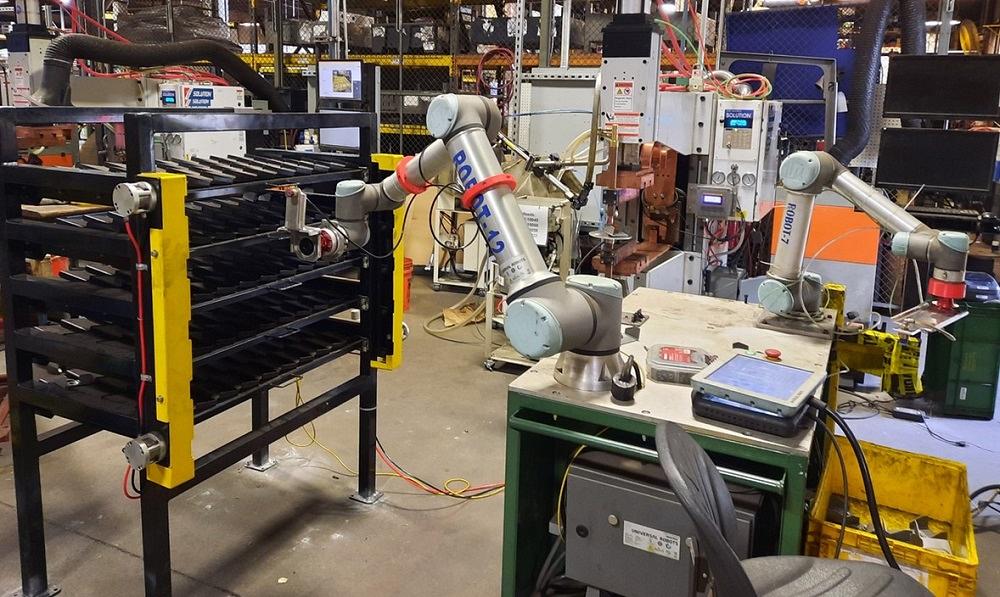 Predictive maintenance
 Failures flagged weeks before the breakdown
Vibration, temperature and current from three critical machines feed an anomaly model that flags deviations weeks before failure. Maintenance planned around production instead of around breakdowns starting with the assets that hurt most, not a full-plant rollout.
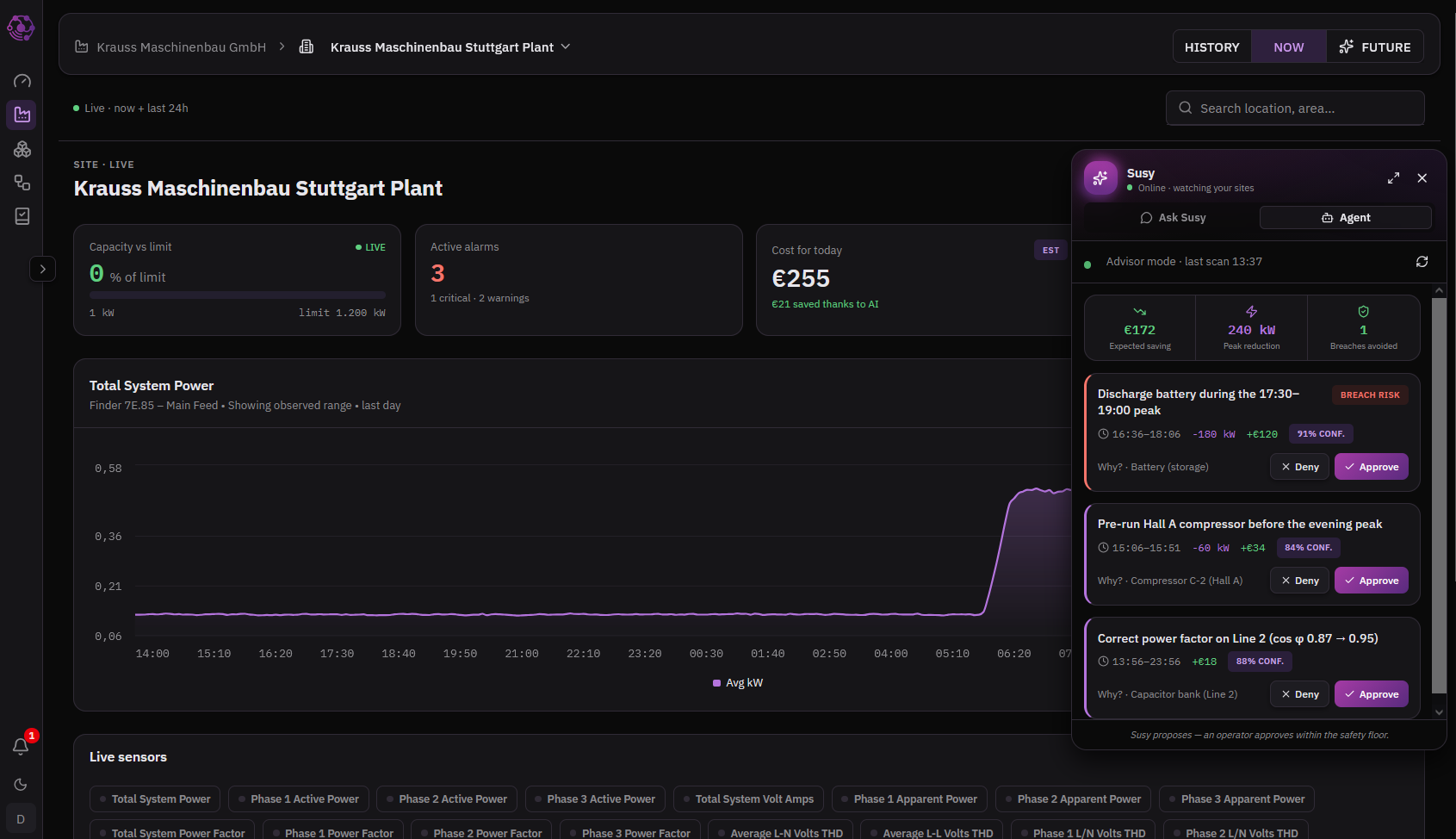 Peak shaving
 Staying under the grid limit without stopping production
Live load monitoring across the site, with automations that shift and shed non-critical consumers before the peak hits the contracted limit. No heavier grid connection the one the grid operator wouldn't grant anyway but production planned around the power that is there.
Frequently asked questions about agentic AI in manufacturing
What is agentic AI?
Agentic AI is AI that pursues a goal on its own initiative, within boundaries you set. Instead of waiting for a question, an agent watches its domain, draws conclusions and takes or prepares actions. That initiative is the 'agentic' part: it acts on triggers, not on prompts.
What is the difference between an AI agent and a chatbot or copilot?
A copilot answers when you ask; an agent comes to you. A chatbot is reactive: no question, no output. An agent watches continuously, flags on its own initiative and prepares the follow-up. In MeshOS the two work together: the copilot answers your questions, agents guard the floor.
What is agentic AI in manufacturing?
In manufacturing, agentic AI means agents running on live machine data: they watch lines and processes, flag deviations with the context attached and prepare the follow-up, from work orders to shift reports. The value sits in continuity: an agent checks every value in every shift, which no team can keep up by hand.
What are examples of AI agents in a factory?
Common ones: a downtime watcher that classifies stops and flags recurring patterns, a quality agent that spots drift during the batch, a shift report writer, a maintenance agent that prepares work orders, and an energy guard that watches your grid limit. Which one pays off first depends on where your hours and losses sit.
Can an AI agent control our machines?
Not on its own judgment. Actions that touch the process run through approval rules you define, and anything safety-related stays in the control layer, where it belongs. Most agents start fully advisory: they flag and prepare, people decide. Automation only follows for actions with a proven track record, and only where you allow it.
What data does an AI agent need?
Live data with context. An agent that only sees a value change cannot judge it: it needs to know which machine, order, batch and shift the value belongs to. That is exactly what MeshOS adds to raw machine data, and why agents in MeshOS skip the data plumbing project that stalls most agent pilots.
Do we need MeshOS before we can start with agents?
In practice, yes: an agent needs a live, contextualized data foundation, and MeshOS is how we provide one. If your machines are already connected to MeshOS, a first agent builds on what is there. If not, we start with connecting one line, which is how every other MeshOS module starts too.
Why do so many agentic AI projects fail?
Mostly through rising costs, vague business value or risk that never gets under control: for exactly those reasons, Gartner expects over 40% of agentic AI projects to be canceled by the end of 2027. The failures we see share a pattern: pilots on data exports, agents without context, no route from flag to action and no defined boundaries. All four are avoidable, and none of them are AI problems.
How do we stay in control of what an agent does?
Three mechanisms: boundaries per action (what it may do alone, what waits for approval), an audit trail of every observation and action, and an advisory-first start so nothing is automated before it has proven itself. You can always replay why an agent did what it did.
Does an agent replace our people?
No. It replaces the watching and the typing: monitoring screens, writing reports, chasing status. Judging, fixing and improving stay human work, and with technicians scarce, that is the point: their hours go to work only they can do.
We already have alarms in our SCADA. What does an agent add?
Correlation and context. Alarms fire on thresholds, one signal at a time, and they are famously noisy. An agent combines signals, knows normal behavior per product, suppresses the noise and attaches context and follow-up to the one flag that matters. It complements your alarms; safety-critical alarming stays in SCADA.
How quickly can a first agent be live?
With machine data already in MeshOS: a first agent typically runs in advisory mode within 4 to 6 weeks, including tuning on your real data. Without a data foundation, connecting one line comes first; that lead time depends on your machines.
Put the first agent on watch
Pick the watch job that costs your team the most: the night stops nobody explains, the handover typed from memory, the drift you keep catching too late. Tell us the outcome you are after, and we will tell you honestly whether an agent gets you there.