

Apr 15, 2026
What is a Unified Namespace and why does industrial AI need one?
What is a Unified Namespace (UNS)? Learn how this data layer gives all your factory data context, why that is the foundation for AI and how to get started.
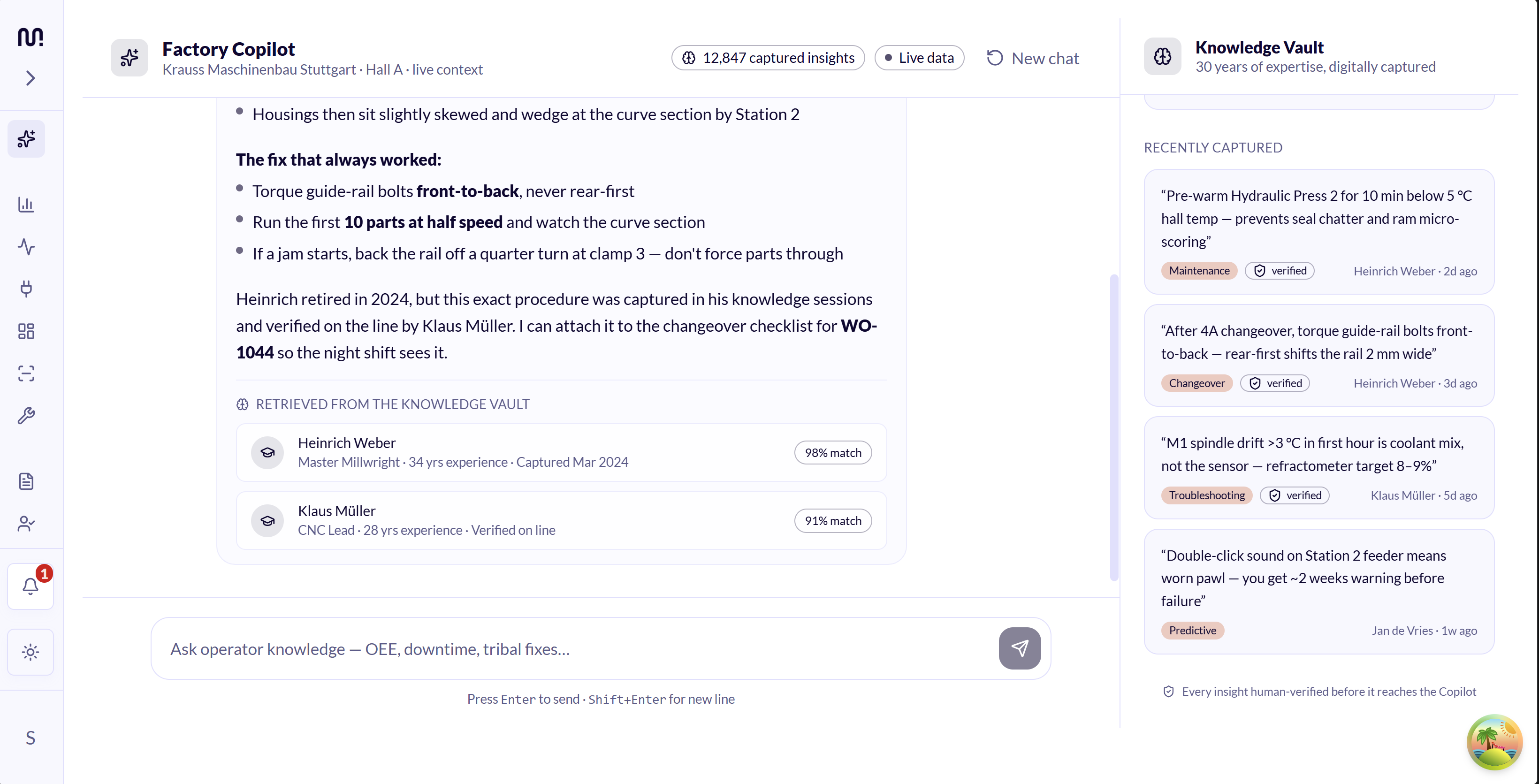
What is a Unified Namespace (UNS)?
A Unified Namespace (UNS) is an architectural pattern in which all business and production data flows through one central, structured data layer. Every machine and every system publishes its current state in one place, and every system that needs data reads from that same place. The UNS is the single source of truth for the current state of your entire factory.
Important to know: a UNS is not a product you buy, but a design decision. You build it with existing technology, usually around an MQTT broker, and it grows with your factory. The pattern was popularised by the American Industry 4.0 architect Walker Reynolds and has since been adopted across the industrial world, up to the reference architectures of the large cloud platforms. Its power is not in the technology itself, but in the agreement underneath it: all data gets a logical name, a fixed structure and context.
And that context is exactly why the UNS is getting so much attention right now. Anyone who wants AI to work in a factory quickly discovers that the bottleneck is not the model, but the data. More on that below.
The problem: data silos and integration spaghetti
In the average factory, every system only talks to its direct neighbour. The PLC talks to SCADA, SCADA to a historian, the MES to the ERP, and every new report means building yet another connection. Each connection is custom work: its own format, its own naming, its own maintenance. With ten systems, dozens of crosslinks appear that nobody fully oversees anymore.
Many manufacturers know the result all too well: the same measurement exists three times under three different names, nobody knows which version is correct and every data project starts over with digging and cleaning. The data is there, but it is locked in silos. As far back as 2015, McKinsey found that less than one percent of the data from the 30,000 sensors on an offshore oil platform was used for decision making, a picture many factories still recognise today.
A Unified Namespace flips this model. Instead of wiring systems directly to each other, every system publishes its data once to the central data layer. Whoever needs data subscribes to it. Connecting a new dashboard, a new integration or a new AI model no longer means building an integration; it simply means reading along. This is the core of modern IT and OT integration.
How does a Unified Namespace work? MQTT and the naming structure
Technically, a UNS usually consists of a central message broker, almost always based on MQTT, surrounded by edge devices that unlock machines and sensors. Systems publish their data to the broker following the publish/subscribe principle, typically reporting only when something changes (report by exception) instead of being polled continuously. That is lightweight, fast and scalable.
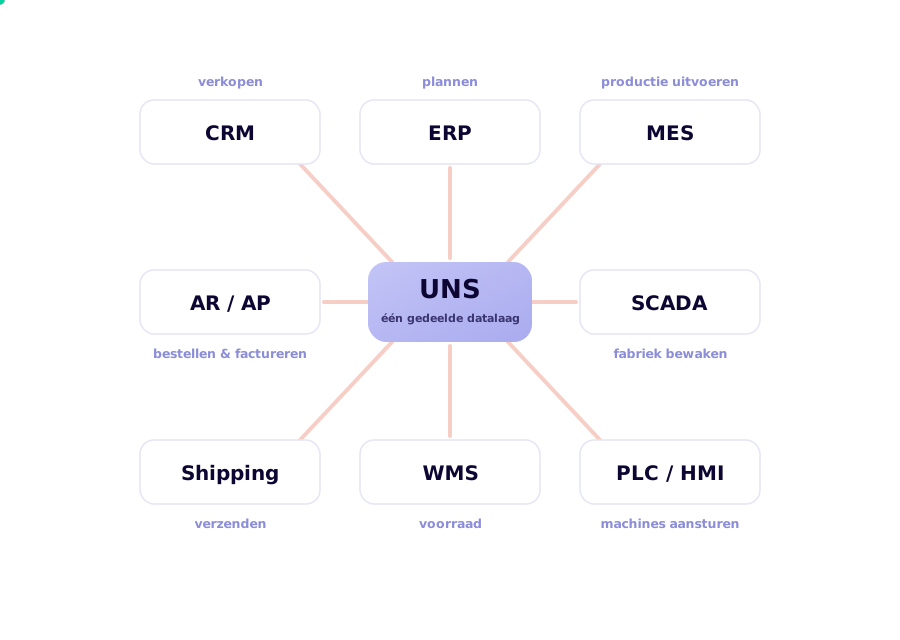
The heart of the UNS is the naming structure. Every value gets a path that follows the structure of your business, often inspired by the ISA 95 standard: enterprise, site, area, line, machine. A temperature is then not called TT104, but for example:
Meshnex/Utrecht/Packaging/Line2/FillingMachine/Temperature
That path tells you at a glance which temperature this is, from which machine, on which line and at which site. Add the unit, timestamp and state, and every value explains itself. It looks like a detail, but it is the core of the whole pattern: the meaning travels with the data.
Good to know: the UNS contains the current state of your factory, not its history. For history and trends you connect a historian or time series database as a subscriber, storing everything that passes by in the same structure.
Why context makes the difference for AI
Now for the real story. Analyst firm Gartner predicted in early 2025 that through 2026, sixty percent of AI projects that are not supported by AI ready data will be abandoned. Not because the models fall short, but because the data is not ready for them. In manufacturing this is painfully familiar: most factories have mountains of data and hardly any context.
An AI model that receives the value 74.3 can do nothing with it. Does that value belong to a filling machine or an oven? Is it degrees or bar? From which line, during which batch, for which product? Without that context every analysis is guesswork, so every AI project today starts with weeks of manual work to collect, decipher and clean data. And for every next project: all over again.
A Unified Namespace solves this structurally, for three reasons:
- Context travels with the data. The path, the unit and the timestamp tell a model exactly what it is looking at. Data from the UNS carries meaning by definition, and that meaning is structured the same way for every machine and every line.
- Connect once, access everything. An AI application subscribes to the data layer and immediately has access to the current state of the whole factory. No custom integration per project, no waiting for the IT department.
- AI assistants can find their way around. A language model can browse a logical naming structure the way you browse a folder structure. Ask your factory copilot why line two stopped last night, and thanks to the UNS it knows exactly where the relevant data lives.
In short: the UNS turns raw signals into meaningful information, and that is exactly what AI needs. Get your data layer in order first and every next AI project becomes faster and cheaper. Skip it, and you pay the bill again on every single project.
What can you do with it? AI applications on a UNS
With a well filled Unified Namespace as the foundation, applications that used to take months suddenly become manageable:
- Predictive maintenance: models recognise deviating patterns per machine, because vibrations, temperatures and cycle times share the same structure and context everywhere.
- Quality monitoring: process data and results from machine vision and AI come together in the same data layer, so you can trace rejects back to process conditions.
- Energy optimisation: consumption per machine and per product becomes comparable across lines and sites, the foundation under energy management.
- Digital twin: a platform such as MeshOS subscribes to the UNS and maintains a live digital model of your factory.
- AI assistants on the factory floor: operators and engineers ask questions about downtime, quality and consumption in plain language, and the assistant finds the answer in the structured data layer.
How to get started with a Unified Namespace
You do not build a UNS for the whole factory in one go. The successful route is the same as with every digitalisation step towards Industry 4.0: start small, prove value, expand.
- Design your naming structure. Follow the structure of your business: site, area, line, machine. Use ISA 95 as a guideline, not as dogma. Consistency matters more than perfection.
- Unlock one line. Read the PLCs through existing protocols, add sensors where needed and let an edge device publish the data to the broker. Production does not notice a thing.
- Add context at the source. Give every value the right name, unit and meaning at the moment it enters the UNS. Adding context afterwards is exactly the manual work you want to abolish.
- Connect consumers. A dashboard, a historian, a first AI application: every new system is now a subscriber instead of a project.
- Arrange governance. Agree who owns the naming structure and how changes are handled. A UNS is a small part technology and a large part agreements; without an owner the structure erodes.
Frequently asked questions about the Unified Namespace
Is a UNS just an MQTT broker?
No. The broker is the technology you usually build a UNS with, but the pattern is about the structured naming and the agreement that all systems communicate through that one data layer. A broker without a well designed structure is not a Unified Namespace yet.
What is the difference between a UNS and a data lake?
A data lake stores large amounts of raw data for analysis after the fact. A UNS is the live data layer that shares the current state of your factory, complete with structure and context. They complement each other: the UNS delivers the structured stream you fill a data lake or historian with.
Does a UNS replace my historian or SCADA?
No. SCADA keeps controlling and monitoring, the historian keeps storing history. The UNS is the common layer through which those systems share their data with the rest of the organisation, instead of through separate point to point connections.
Do I need Sparkplug B for a UNS?
Not necessarily. Sparkplug B is a useful standard for structuring MQTT messages, but a UNS also works fine with well designed naming and payloads of your own. Choose what fits your systems and suppliers; the consistency of your structure matters more than the protocol.
Is a Unified Namespace only for large companies?
No. The UNS is attractive precisely for smaller manufacturers: you start with one broker and one line, and every extension reuses what is already there. The investment grows with the value, instead of requiring a big platform up front.
Conclusion: context is the foundation under AI
The question is no longer whether AI is coming to the factory, but whether your data is ready for it. A Unified Namespace gives all your machine data one structure, one place and one meaning, and that is exactly the context AI needs to deliver value. Start small, build the structure carefully, and every next project, from dashboard to AI assistant, becomes faster and cheaper than the last.
Meshnex designs and builds Unified Namespace architectures for manufacturers, from the first PLC connection to a complete digital twin with AI. Curious what that looks like in your factory? Contact us or read more about our approach.