



Robots and cobots
Robotics for manufacturing.
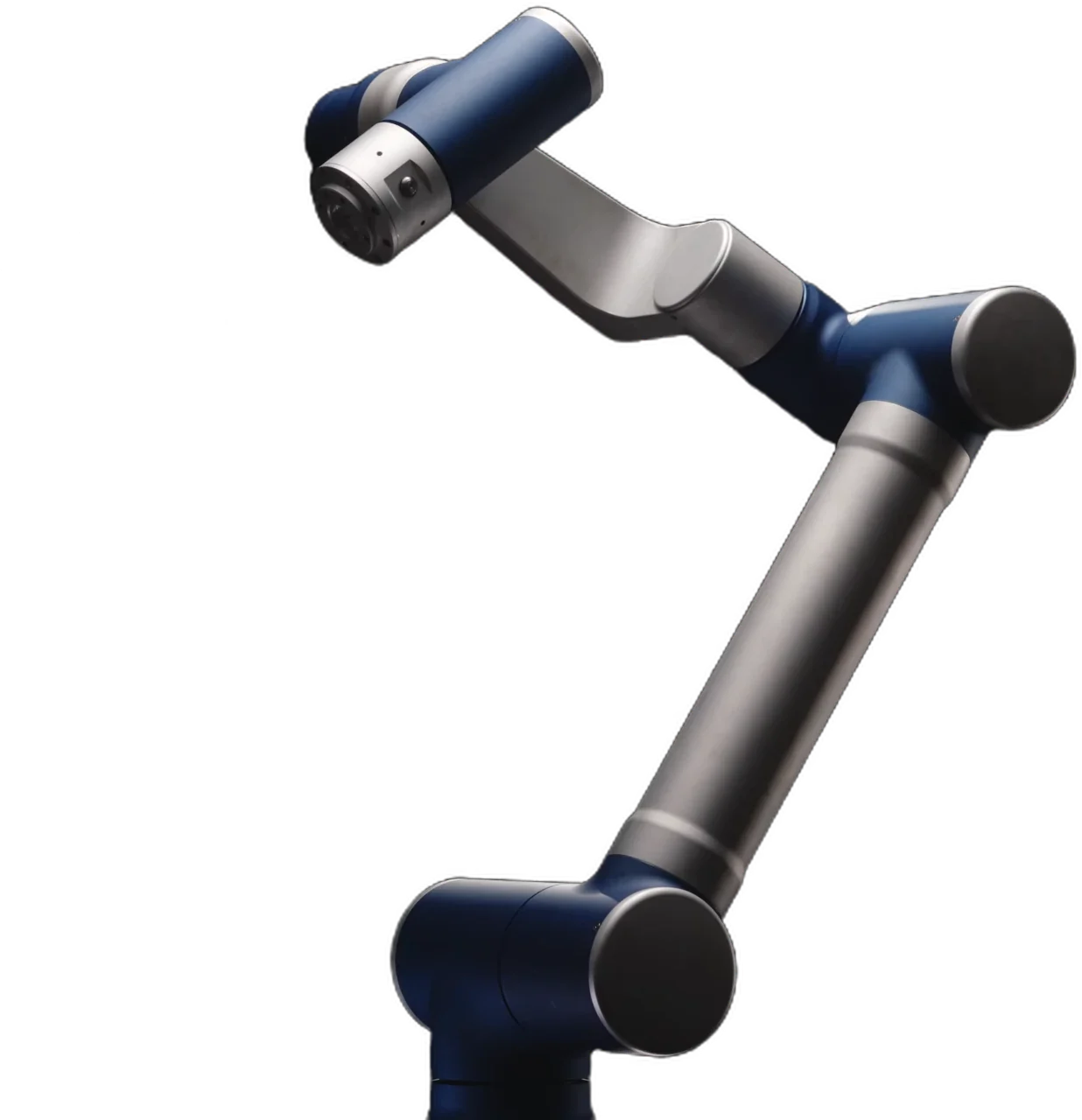
We design and commission robot cells for packing, palletising and machine tending. The robots come from our partner, an industrial robot maker. We write the software and integrate them with your line and our digitalisation platform MeshOS.
In short
It is getting harder to find people for heavy, repetitive work. A robot can take it over. We pick it, program it and start it up at your plant.
What you gain
The line keeps running
The robot works even when people are short.
Less lifting
People move from carrying to supervising.
A steady pace
The same on every shift, at night too.
Payback on your numbers
Worked out from your hours and shifts, not from a brochure.
Applications
What a robot can take over.
We start with the work that tires people most or stops the line most often.
01 / 04
Palletising
Stacking cartons and crates on pallets, and taking them off.
You get: Full pallets without lifting.
02 / 04
Packing
Placing products in cartons, crates and trays.
You get: A steady packing pace on every shift.
03 / 04
Machine tending
Loading and unloading machines, on the night shift too.
You get: The machine runs when the operator is away.
04 / 04
Pick and place
Picking products up and placing them between stations.
You get: Less moving things by hand.
Who does what
Who does what.
The robot from the maker. The whole cell from us.
Robot
Our partner supplies the robot, controller, parts and service.
Concept
We check the cell layout and cycle in a simulation.
Software
We program the robot and connect it to the line and the PLCs.
Commissioning
Tests, operator training and support after go-live.
Vision and AI
A robot that can see.
With a camera, the robot recognises the product and where it lies, so products don't have to be perfectly placed. Where products vary, AI helps.
Data from the robot goes into MeshOS, next to the rest of the line.
Vision systemsHow we work
How we work.
- 1
Visit on site
We look at the station, the product, the pace and the space.
- 2
Concept and simulation
You see the cell layout and cycle in a simulation.
- 3
Testing
We test the cell with your product before it starts work on your line.
- 4
Roll-out and support
Installation, operator training and service after go-live.
Questions
Clear answers before you start.
Is your question not here? Write or call, an engineer answers.
-
How do you know the cell will work?
First in a simulation, then in tests with your product. Only a tested cell goes onto your line.
-
Who supplies the robot?
Our partner, a robot maker, supplies the robot, controller, parts and service. We design the cell, program the robot and run it on your line.
-
What does a robot cell cost?
The robot itself is usually the smaller part. The rest is the gripper, guarding, software and integration. You get a quote after the visit and the concept.
-
What about the people doing this work today?
They move to running and supervising the cell. We train them at go-live.
Contact
Heavy work on your line and not enough people?
Describe the station, the product and the number of shifts. An engineer replies within one business day.

-
Utrecht
Netherlands · Rijnzathe 12, 3454 PV Utrecht
+31 85 401 0906 -
Chojnice
Poland · Karolewo 17b, 89-600 Chojnice
+48 696 369 415 - info@meshnex.nl